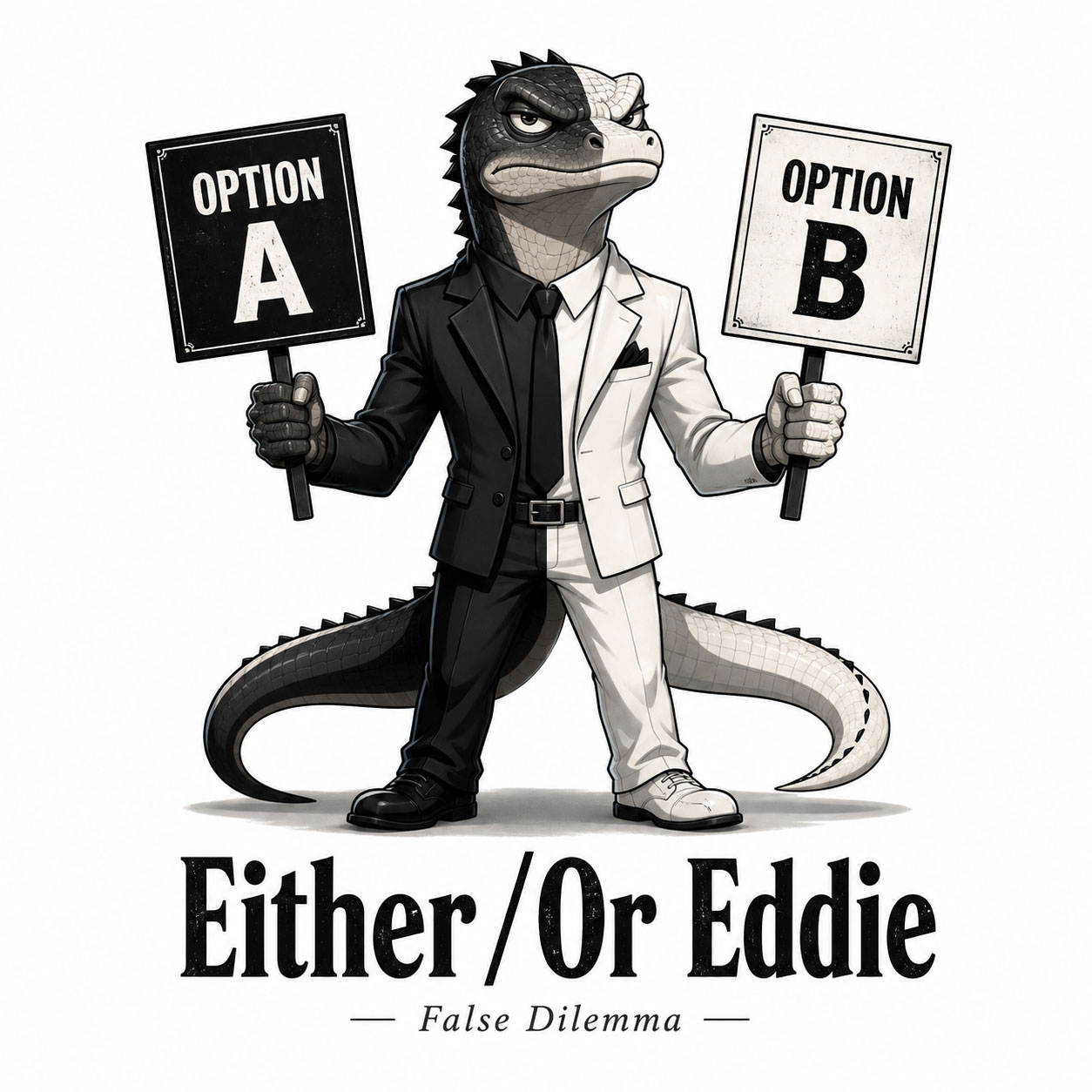
False dilemma
Either-Or Eddie
“You're either with me or you're against breakfast.”
What's the problem?
A false dichotomy (or false dilemma) presents two options as the only possibilities when the context shows other realistic ones: a middle position, a combination, or a different choice altogether. Not every either-or is fallacious. A genuine binary ("the measure passes or it fails") or an explicit, binding constraint can justify a two-option framing. But having only two bids in hand, or a form with one box, doesn't by itself show that the underlying options are exhaustive. Naming another option doesn't make it better, and a proposal alone doesn't show that it is feasible or would work. Eddie asks whether the options were wrongly narrowed; Circular Sally asks whether a conclusion is assumed, and Straw Man Stan whether a position was misrepresented.
Context: A team is behind on a project. Weekend work is one option. Extending the deadline, adding staff and reducing scope are also feasible ways to address the delay, alone or combined, though none is guaranteed to succeed.
- ✗ Choice narrowed
- Either we work every weekend or we miss the deadline.
- ✓ Options assessed
- We're behind. We can consider weekend work, extending the deadline, adding staff or reducing scope, alone or combined, and weigh which is most likely to help.
- Why it works
- The original hid feasible options. The revision restores them for assessment without promising that any one will work.