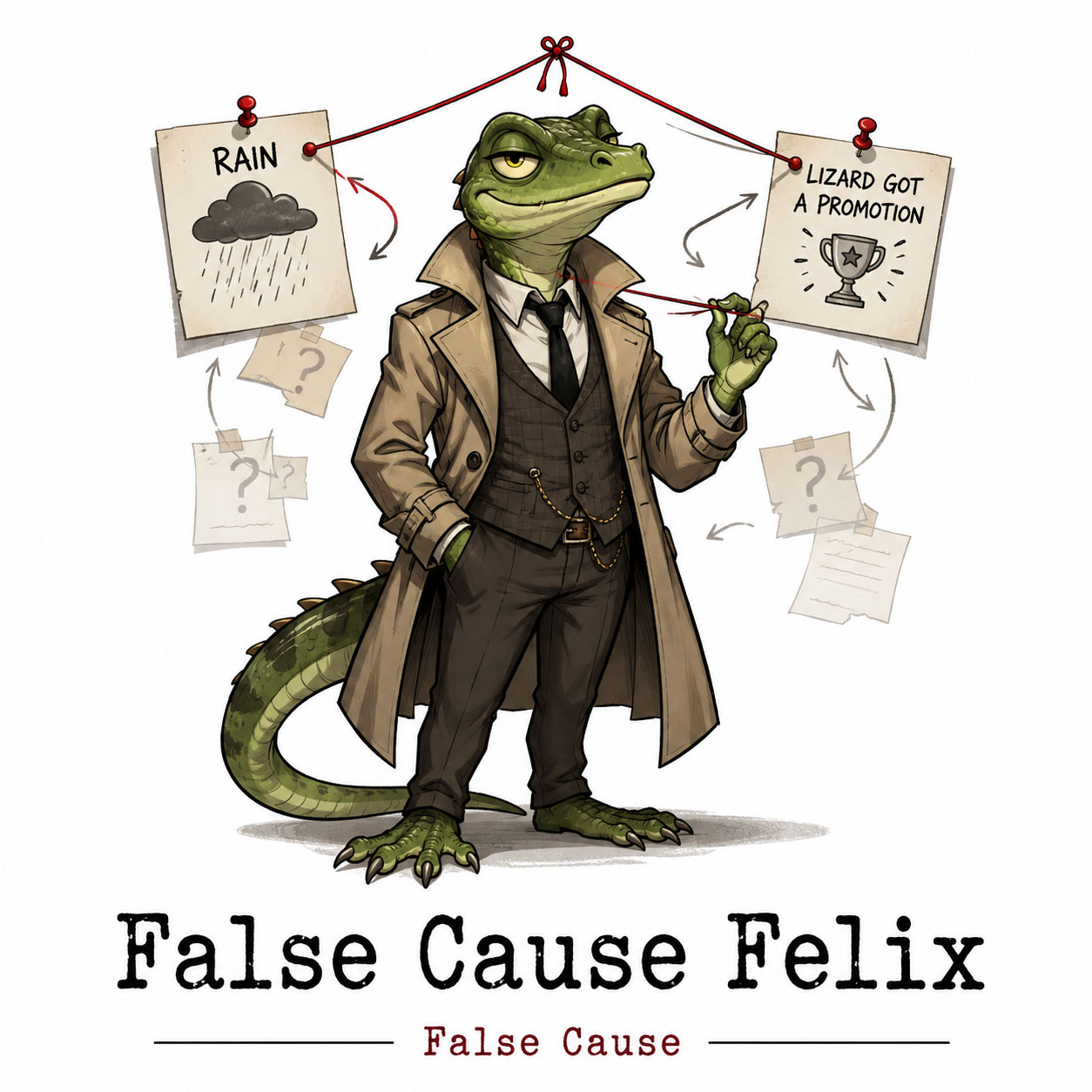
False cause
False-Cause Felix
“It rained, then I got promoted. Coincidence? I think not.”
What's the problem?
A false-cause error concludes that one thing caused another from evidence that can't show it: one thing simply came first, or two things rise and fall together. Timing and correlation can give clues about causes, but on their own they usually don't establish one. Common gaps: a third factor drives both (confounding), the cause may run the other way (reverse causation), or the pattern is coincidence or normal ups and downs. Causal claims aren't automatically fallacious, and cause isn't impossible to assess. Randomized trials are strong evidence but not the only kind. Alternative explanations, fair comparisons, plausible mechanisms and replication all affect how much confidence is warranted; none of them alone guarantees a cause. Felix asks what caused it; Ollie and Harry ask how far a claim reaches and whether the cases are enough.
Context: A cafe started playing jazz in March, and sales rose 15% that month. An office building next door also opened in March.
- ✗ Cause assumed
- The jazz boosted our sales.
- ✓ Cause weighed
- Sales rose 15% in March, the same month we started jazz and the office next door opened. We can't tell yet which, if either, made the difference.
- Why it works
- The timing is real, but two changes happened at once. The revision keeps the facts and leaves the cause open without dismissing the jazz.