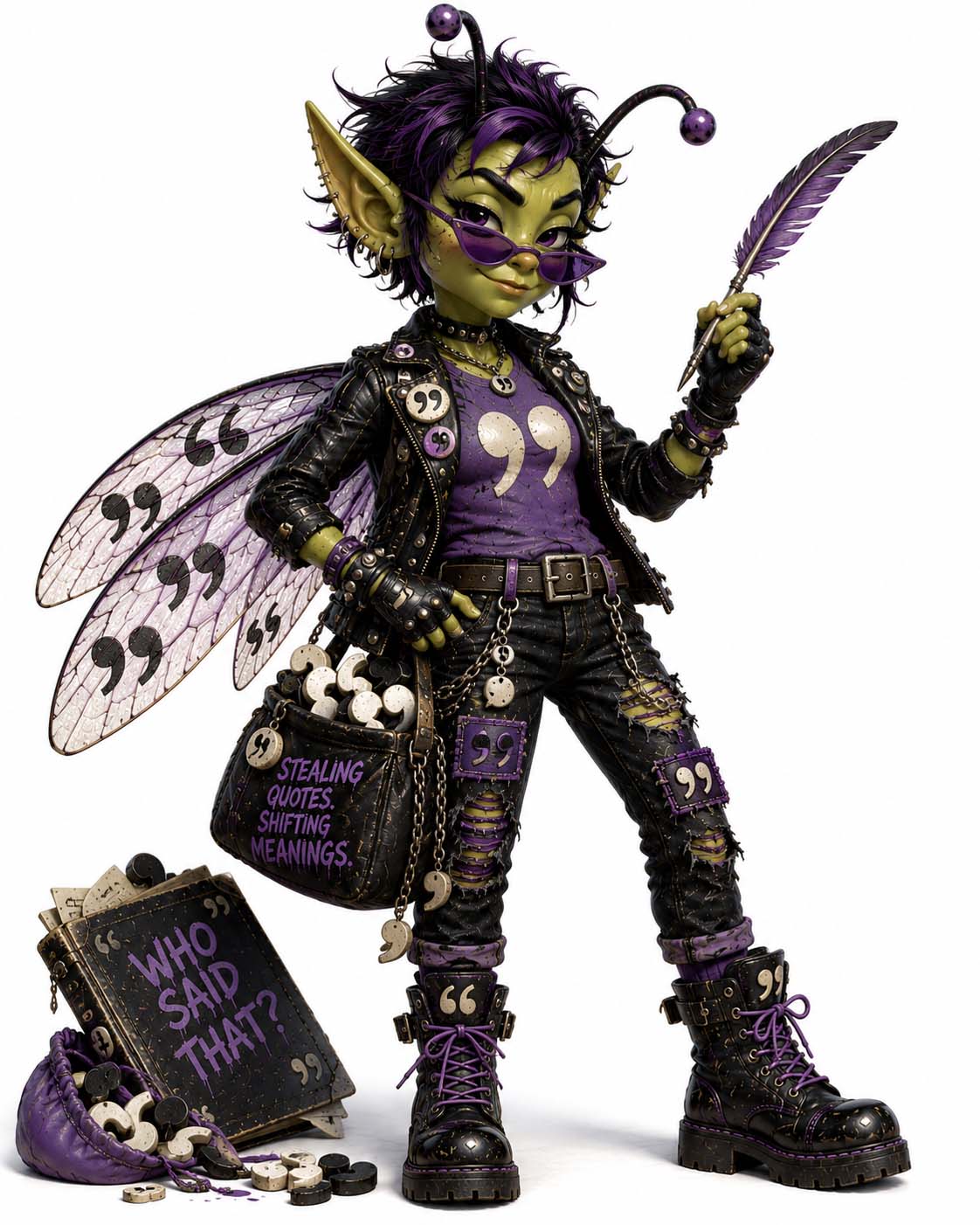
Quotation marks
Quotation Quinn
“Stealing quotes. Shifting meanings.”
What's the problem?
Quotation marks claim exact words. A direct quotation reproduces a speaker's or source's exact words inside quotation marks; an indirect paraphrase reports their meaning in your own words and takes no quotation marks. If you don't have someone's exact words, paraphrase rather than invent a quotation. Our American house style uses double marks for a quotation and single marks for a quotation inside a quotation. Periods and commas go inside the closing mark; colons and semicolons go outside. A question mark or exclamation point goes inside when it belongs to the quoted words and outside when it belongs to the whole sentence; when both are questions, house style uses one mark, inside. Article and chapter titles take quotation marks, while book and periodical titles take italics; other styles differ. Some editorial standards allow a disclosed or style-permitted change to a quotation's capital letters. In these exercises, keep the supplied words and capitals exactly, changing only the punctuation at the edges of the quotation to fit the attribution and house style.
Context: Lena's exact words, spoken as a complete statement: The lab opens at noon
- ✗ Quotation trouble
- Lena said "the lab opens at noon".
- ✓ Structure clear
- Lena said, "The lab opens at noon." (Paraphrase, also correct: Lena said that the lab opens at noon.)
- Why it works
- The quotation keeps Lena's exact words and her capital "The," a comma introduces it, and the period goes inside the closing mark. The paraphrase reports her meaning without claiming exact words, so it takes no quotation marks.